




If you are in the business of sourcing or trading Indian spices, one commodity deserves your close attention right now: fennel seeds. Once considered a niche ingredient, fennel is now one of the most actively traded spices in the world. Over the last 12 months, the growth rate of fennel seeds exports and imports both stood at 23%. That is not a small uptick. That is a structural shift in global demand.
So where exactly is the demand coming from? And what do you need to know before you tap into it? This guide breaks it all down.
The numbers speak for themselves. The fennel seeds market grew from USD 787.89 million in 2024 to USD 847.98 million in 2025, and is expected to continue growing at a CAGR of 7.56%, reaching USD 1.22 billion by 2030.
That growth is not accidental. It is being driven by three clear forces.
First, food manufacturing. The food and beverages application segment accounted for 58.7% of total fennel seeds market revenue in 2025, with demand spanning bakery and confectionery, meat processing, dairy flavoring, beverage production, savory snacks, spice blends, and ready-to-eat meals.
Second, herbal wellness. The global herbal medicine market value exceeded USD 280 billion in 2024, making it a demand driver for fennel seeds pharmaceutical applications. Demand for fennel seed oil is accelerating in cough syrups and antispasmodic medications.
The third factor that is fueling growth is organic demand. Demand for organic fennel seeds has grown by over 25%, driven by the global shift toward chemical-free and naturally cultivated products. The clean-label movement has further enhanced consumer interest in organic and traceable spice options, pushing fennel seeds into premium product categories.
The momentum is real. The question is who is buying.
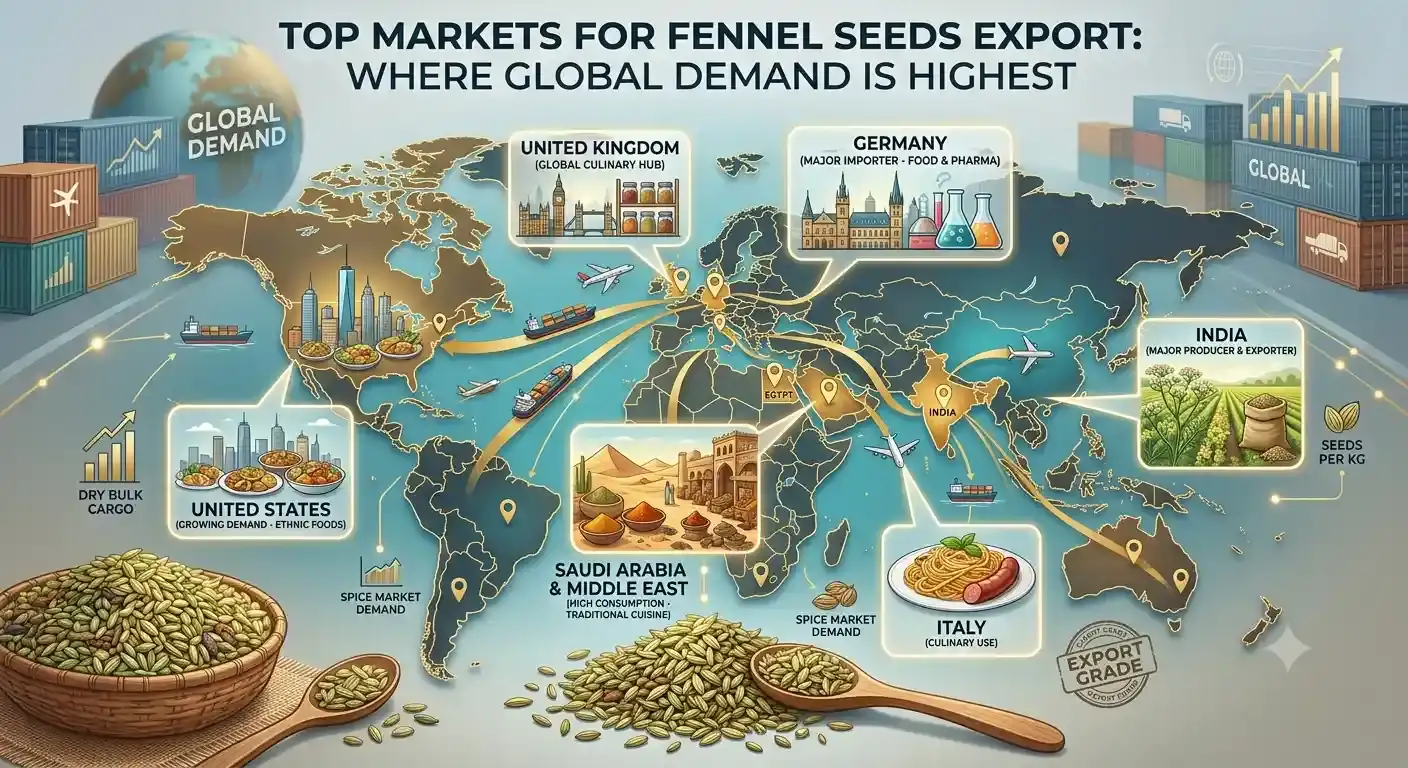
According to global trade data from June 2024 to May 2025, the world exported fennel seeds to 130 different countries. The top three importers, the United States, Nigeria, and Malaysia, collectively accounted for 47% of total world fennel seeds exports. Here is a closer look at each major market.
1. United States
The United States is the dominant player. The USA held 37% of global import shipments with 4,021 shipments, leading global dependency on imports. Nearly 21% of US consumers prefer fennel seeds in herbal teas, dietary supplements, and functional beverages. Around 27% of demand is driven by wellness trends, with 19% attributed to the growing organic and clean-label segment. Nearly 24% of product demand comes from bakery and confectionery applications.
Domestic production covers under 10% of US market demand, which means importers here are not just buyers of convenience. They are buyers of necessity.
2. Europe: Germany, Italy, and France
Europe is the second-largest consuming region. With nearly 42% consumption concentrated in Asia-Pacific and 28% in Europe, the global fennel seeds market is being shaped by growing consumer preference for natural herbs. Within Europe, Germany leads. Germany registered USD 0.07 billion in 2025, accounting for a 24% share, expanding at a CAGR of 6.9% owing to growing pharmaceutical and nutraceutical adoption.
Italy and France bring strong culinary demand, because here, fennel is a fundamental spice for giving cuisines traditional flavors. The EU also enforces some of the world's strictest MRL (Maximum Residue Limit) standards, so quality compliance is non-negotiable for this market.
3. Middle East: UAE and Saudi Arabia
The Middle East is a high-volume buyer with deep-rooted culinary and herbal traditions. Fennel seeds are a core ingredient in Middle Eastern spice blends. Regions like the Middle East are show a trend of rising consumption. The UAE functions both as a direct import market and as a re-export hub for the broader GCC region and that makes it a strategically important destination for any serious fennel seeds exporter.
4. Bangladesh
Bangladesh trades mostly with India specifically. The top three importers of Indian fennel seeds were the United States, Canada, and Bangladesh, collectively accounting for 56% of India's total exports. The United States led with 30%, Canada followed with 13% or 340 shipments, and Bangladesh accounted for 13%. Demand in this country is driven by culinary use and a large population with strong spice consumption habits.
5. Nigeria and Malaysia: High-Growth Emerging Markets
Do not underestimate these two. The United States was the largest importer receiving 25% or 863 shipments, with Nigeria following at 11% or 363 shipments and Malaysia at 11% or 361 shipments. Both markets are growing fast, fueled by expanding food processing industries and increasing demand for Indian spices among diaspora and local populations alike. Top year-on-year export shifts for fennel seeds also include Morocco at +621.4% and South Africa at +177.1%, signaling that Africa as a whole is emerging as a region worth watching.
Getting the product right is only half the battle. The paperwork needs to be airtight. Here is what every fennel seeds exporter must have in order.
HS Code: The EXIM code for fennel seeds is 09096230. Fennel seeds, scientifically known as Foeniculum vulgare, are classified under this code as a spice and flavoring agent used in various cuisines worldwide.
Commercial Invoice: A detailed commercial invoice specifying the quantity, value, and description of fennel seeds being exported is required.
Packing List: A packing list enumerating the contents of each package, including net and gross weights, packaging dimensions, and markings, must be included.
Bill of Lading or Airway Bill: A bill of lading for sea shipments or an airway bill for air shipments serves as a contract of carriage and a receipt of goods from the carrier.
Certificate of Origin: A certificate of origin issued by the relevant chamber of commerce or authorized agency confirms the country of origin of the fennel seeds.
Phytosanitary Certificate: A phytosanitary certificate issued by the Plant Quarantine Authority verifies that fennel seeds comply with the phytosanitary requirements of the importing country. This certificate is the guarantee that the fennel seeds supplied are free from pests and diseases. Without an authentic phytosanitary certificate, customs entry of the importing nation can be denied, leading to resubmissions, fines, and destruction of the commodity.
Certificate of Analysis (CoA): Every consignment should be tested for moisture, volatile oil, ash, and pesticide residue where applicable and accompanied by a Certificate of Analysis from NABL or FSSAI-approved labs.
Regulatory Registrations: Exporters must be registered by regulatory trade bodies. Tha means having an FSSAI license, IEC (Import Export Code), and APEDA alignment. Additionally, the USA market requires additional licences like FDA Food Facility Registration and Prior Notice for each shipment. The EU region goes an extra length and requires strict compliance with MRL limits for pesticides.
Packaging is not just about presentation. It directly affects shelf life, and aroma retention. Moreover, it is also crucial for passing labeling regulations that help to pass port inspections without delays.
Standard Bulk Formats: Standard packaging format for bulk fennel seeds for export is sturdy, food-grade jute bags or polypropylene (PP) bags, usually in sizes ranging from 25 kg to 50 kg. The sturdy bag construction is enough to protect them from physical damage and moisture during transit.
Container Load Capacity: A standard FCL 20-foot container holds approximately 12.50 to 13 MT of bulk fennel seeds. A 40-foot HQ container can accommodate significantly more, making it the preferred choice for large-volume buyers.
Shelf Life and Storage: Fennel seeds maintain premium quality for up to 24 months under ideal conditions. That means storing them in a cool, dry place at temperatures below 25 degrees Celsius. This is away from sunlight, humidity, and pests.
Market-Specific Requirements: Each destination market has its own standards. The EU mandates that salmonella must be completely absent in spices and herbs. The US requires FDA-compliant labeling and prior notice filing per shipment. For the GCC market the emphasis is on halal certification. Exporters targeting multiple markets offer multiple grades for each market, such as Singapore Quality, Europe Grade etc.
You already know the markets. Now the question is: how do you make sure the supplier you choose can actually deliver to them?
Check the Certifications First
The main certifications to look for while vetting an exporter should include ISO 9001:2015 for quality management systems, HACCP certification for food safety and contamination prevention, and organic certification from accredited agencies for fennel seeds grown without synthetic chemicals or pesticides. Additionally, look for FSSAI, APEDA registration, Spices Board of India certification, and USDA Organic if you are supplying the American market.
Verify the Quality Parameters
Skipping this step means losing your market share. Understanding the quality specifications of export-grade fennel seeds is crucial if you want to win the trust of global buyers. Key parameters to focus on are volatile oil content, purity, moisture, and microbiological safety to secure a consistent and high-quality supply. A reputable supplier will always provide batch-level CoA documentation without hesitation.
Ask the Right Questions Before You Commit
Do not lock a deal until you confirm the specifics. That involves requesting pre-shipment samples. Asking for a recent CoA from an accredited third party lab. Other qualifying questions should be about container-readiness, lead times, and documentation protocols. Deviations in quality can lead to product recalls, financial losses, and damage to brand reputation. The right supplier eliminates that risk before it becomes your problem.
Why Partnering with US-Based Supplier with Direct India Sourcing Makes the Difference
This is where Innovative Products and Supplies LLC stands apart. Based in Paramus, New Jersey, Innovative Products and Supplies LLC sources premium-quality Indian fennel seeds directly from trusted farmers and verified suppliers in India. You get the best of both worlds: supply chain integrity of Indian-origin fennel, and the quality assurance of a US-based operation. So if you need bulk fennel seeds for food manufacturing, herbal formulations, or nutraceutical production, Innovative Products and Supplies LLC offers the reliability and market understanding that global buyers depend on.
The global fennel seeds market is not just growing. It is accelerating. The United States, Europe, the Middle East, Bangladesh, Nigeria, and Malaysia are all active, high-volume import destinations, each driven by a distinct combination of culinary demand, wellness trends, and food manufacturing growth. India accounts for 65% of total global fennel seeds export shipments, making Indian-origin fennel the backbone of international supply.
If you are a buyer, distributor, or food manufacturer looking to secure a reliable, quality-certified supply of bulk fennel seeds, now is the right time to build that sourcing relationship.
If you are sourcing bulk fennel
READ FULLIf you are in the business of sourcing or trading Indian spices, one commodity deserves your clos
READ FULLFennel seeds are popular edible items that you can find as a versatile choice for many foods and
READ FULL

Have a question or need a quote? Fill out this form and our team will get back to you quickly!